SN ENGINEERING • GURGAON • PROJECT EARTHING SOLUTIONSIndustrial • Government • EPC • Infrastructure • Railway • Power
Burnished Quality • Project Grade

Electrolytic Grade Copper Earthing for Projects

Long-life, durable and engineering-oriented earthing electrodes for industrial, government, EPC, power, railway, metro, airport, renewable-energy and critical electrical projects.

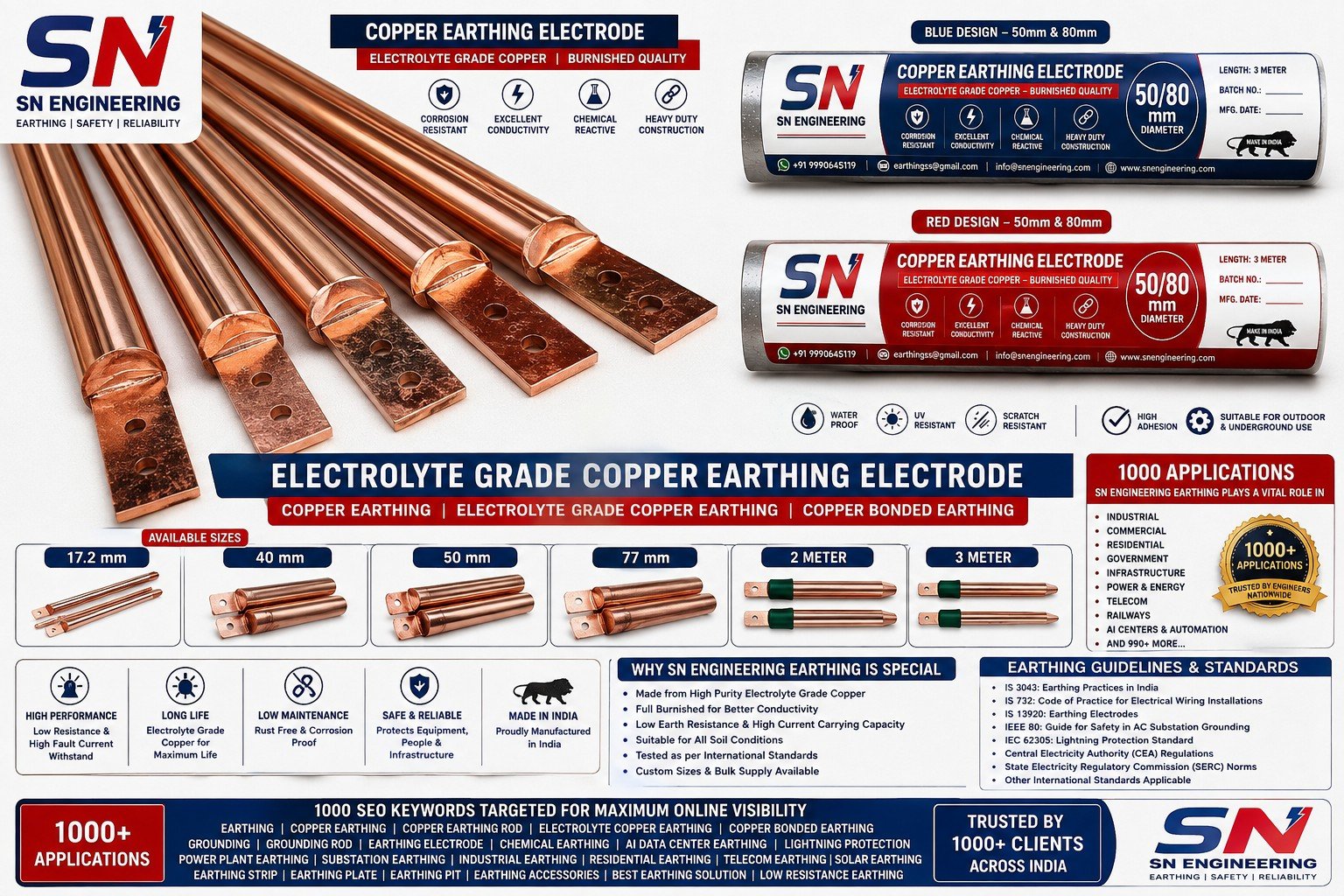
17.2 mm40 mm50 mm77 mm2 m & 3 mBurnished Quality
SN Engineering copper earthing electrode range in 17.2, 40, 50 and 77 mm
PROJECT-GRADE EARTHING
6 Sizes17.2 / 20 / 25 / 40 / 50 / 80 mm
2 m / 3 mProject length options
100Detailed application mappings
AI + GuidelinesEngineering selection support
Earthing Fundamentals

What is an Electrolytic Earthing Electrode?

An electrolytic earthing electrode is an engineered electrode used to create a dependable electrical connection between an installation and the surrounding earth. Copper is widely selected because of its high electrical conductivity and good corrosion resistance for long-term earthing service.

The electrode is only one part of the complete earthing system. Actual performance depends on soil resistivity, electrode depth and spacing, conductor sizing, fault-current duty, bonding, joint quality, backfill material, moisture conditions and the approved electrical design.

In industrial, EPC, utility, railway, infrastructure and government projects, a correctly selected electrode helps provide a stable earth reference and a controlled path for fault, leakage and lightning-related currents where the design requires it.

Why is it needed and why is it used?

  • Helps carry fault and leakage current safely into the earthing network.
  • Supports equipotential bonding and reduction of hazardous touch potential.
  • Provides a stable earth reference for electrical, control and sensitive electronic systems.
  • Supports protective-device operation as part of a correctly engineered fault loop.
  • Forms part of lightning protection and surge-protection earthing where specified.
  • Provides a maintainable point for inspection, earth-resistance testing and continuity verification.
Complete Product Descriptions

Copper Earthing Electrode Range — 17.2, 20, 25, 40, 50 & 80 mm

The product range is now organised in two clear families: solid copper earthing rods in 17.2 mm, 20 mm and 25 mm, followed by larger electrolytic copper earthing electrodes in 40 mm, 50 mm and 80 mm. Each is shown with 2 metre and 3 metre project length options. Final construction and electrical selection must follow the approved BOQ, soil study and project design.

SOLID COPPER

Solid Copper Earthing Rods

17.2 mm • 2 m / 3 m

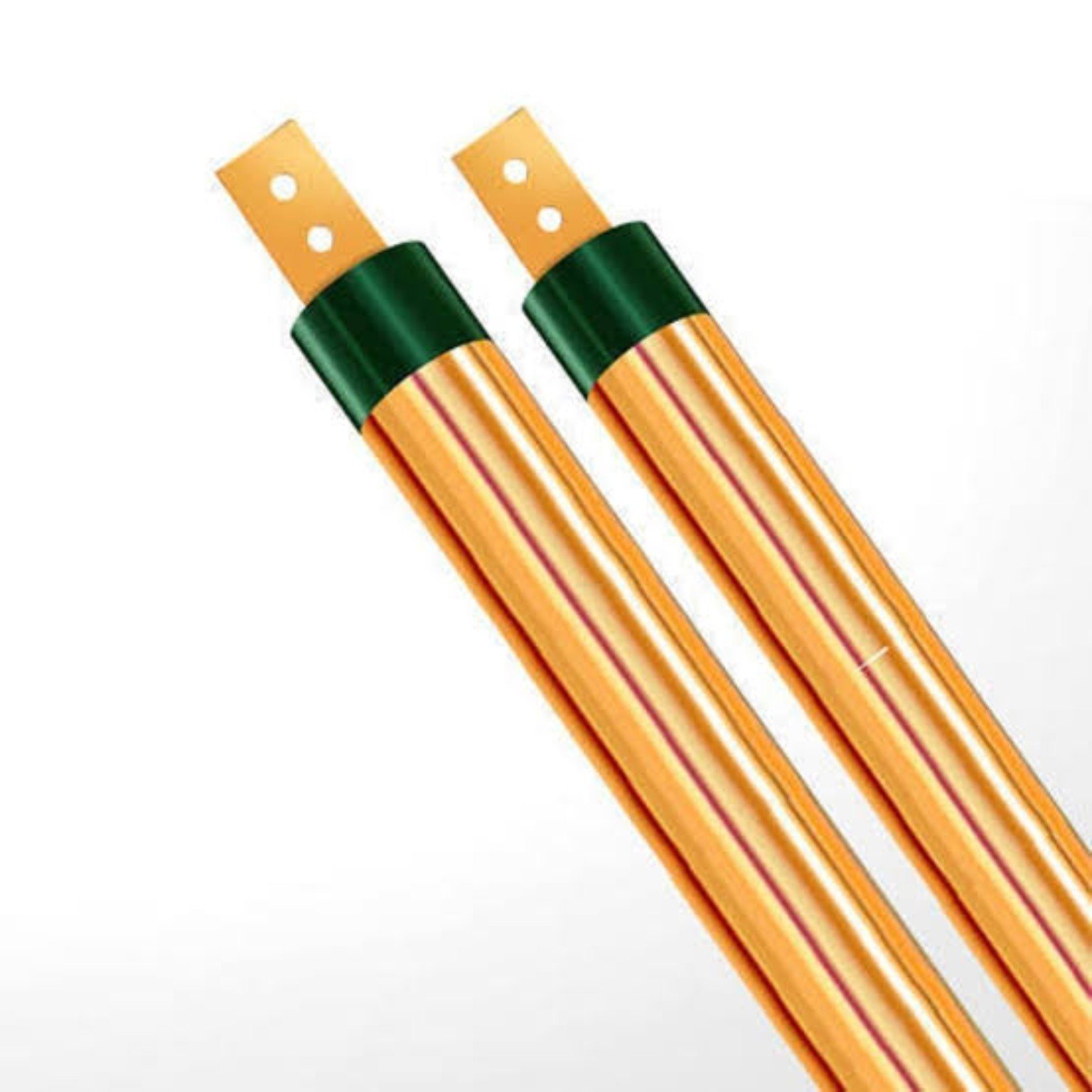
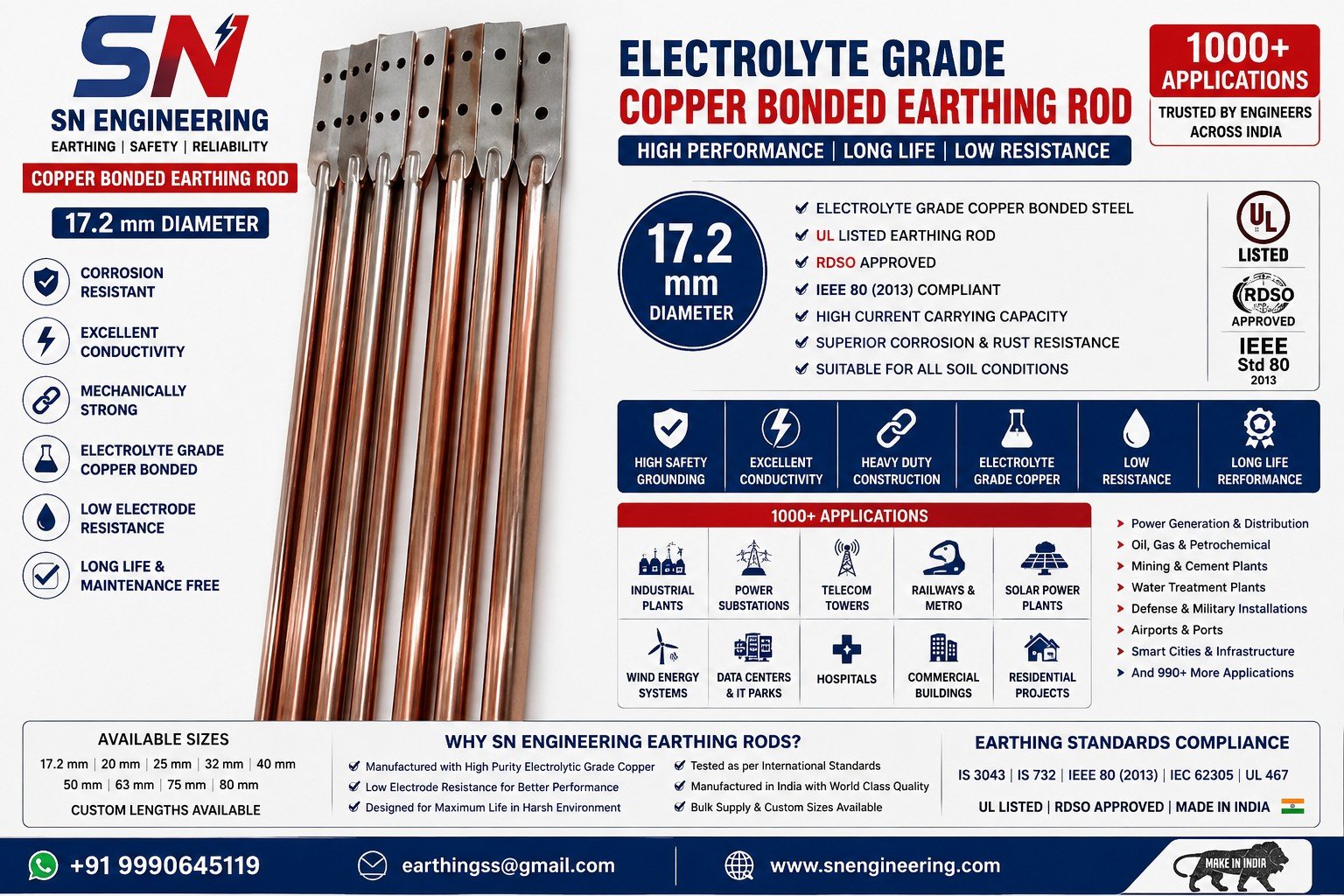
17.2 mm Solid Copper Earthing Rod

Compact solid-copper rod for industrial equipment earthing, lightning earth termination, panels, utility and project earthing networks where this diameter is specified.

ConstructionSolid copper rod
Diameter17.2 mm
Lengths2 metre / 3 metre
Typical useIndustrial, EPC, utility, lightning & equipment earthing
Selection basisBOQ, soil resistivity, fault duty and approved design
20 mm • 2 m / 3 m

20 mm Solid Copper Earthing Rod

Higher-section solid copper rod offering increased copper mass and mechanical section for industrial, infrastructure and utility earthing projects requiring a 20 mm rod.

ConstructionSolid copper rod
Diameter20 mm
Lengths2 metre / 3 metre
Typical useIndustrial, infrastructure, substation and equipment earthing
Selection basisProject specification and approved design
25 mm • 2 m / 3 m

25 mm Solid Copper Earthing Rod

Heavy-duty solid copper electrode option for project earthing where a larger solid-copper section is preferred for durability, conductor interface and mechanical robustness.

ConstructionSolid copper rod
Diameter25 mm
Lengths2 metre / 3 metre
Typical useIndustrial, utility, infrastructure and high-duty project earthing
Selection basisBOQ, soil condition and electrical design
ELECTROLYTIC COPPER

Electrolytic Copper Earthing Electrodes

40 mm • 2 m / 3 m

40 mm Electrolytic Copper Earthing Electrode

Compact electrolytic copper electrode family for general industrial, DG, panel, commercial, renewable-energy and infrastructure earthing applications.

Nominal size40 mm
Lengths2 metre / 3 metre
MaterialElectrolytic-grade copper construction / project-specific
BackfillConductive compound as specified
UseIndustrial, EPC and infrastructure earthing
50 mm • 2 m / 3 m

50 mm Electrolytic Copper Earthing Electrode

Project-grade burnished electrolytic copper electrode for industrial and infrastructure earthing systems. Final terminal, internal strip and compound configuration should follow the applicable SN Engineering TDS and customer BOQ.

Nominal size50 mm
Lengths2 metre / 3 metre
FinishBurnished quality
BackfillSN conductive compound / as specified
UseIndustrial, government, EPC, DG, transformer and project earthing
80 mm class • 2 m / 3 m

80 mm Electrolytic Copper Earthing Electrode

Heavy-duty electrolytic copper electrode family for industrial, utility, substation and infrastructure projects requiring a larger-diameter earthing electrode. Where a 77 mm OD construction is specified, the final TDS/BOQ should govern.

Nominal size80 mm class / project-specific 77 mm OD option
Lengths2 metre / 3 metre
MaterialElectrolytic-grade copper construction
BackfillConductive compound as specified
UseHeavy industrial, utility, EPC and infrastructure projects
Technical note: exact wall thickness, copper purity, inner strip/terminal dimensions, compound properties, current-withstand values and test-report values must be taken from the specific SN Engineering TDS / laboratory report for that model. They are intentionally not invented here.
Why Electrolytic Grade Copper

Conductivity, durability and project maintainability

01

High conductivity

Electrolytic-grade copper is selected for dependable electrical continuity in project earthing networks.

02

Corrosion-conscious

Copper is widely used underground because of its conductive and corrosion-resistant characteristics; actual life depends on soil chemistry and installation.

03

Burnished finish

A smooth, consistent surface supports professional workmanship, inspection and corporate project presentation.

04

Flexible range

Four diameters and two standard lengths allow better BOQ matching across different applications.

05

Complete-system use

Designed to integrate with strips/conductors, test links, chambers, bonding, LPS/SPDs and approved enhancement material.

06

Testing access

A maintainable project should provide inspection and test arrangements rather than burying all connections permanently.

07

Government projects

Supports BOQ mapping, material schedules, test documentation and statutory/departmental review workflows.

08

Industrial projects

Applicable to plants, substations, transformers, DG sets, panels, utilities and process infrastructure when properly engineered.

Technical Engineering Knowledge

What must be checked before final electrode selection

A professional earthing design should not be based on a single generic earth-resistance number. Final selection depends on site, fault and protection conditions.

Design inputs

  • Soil resistivity and seasonal soil condition
  • Prospective earth-fault / short-circuit current and protection clearing time
  • System earthing / neutral philosophy and SLD
  • Touch and step potential / fault-loop performance
  • Electrode depth, spacing, earth-grid geometry and available area
  • Corrosion environment and compatible materials
  • Lightning and surge-protection coordination where applicable
  • Testing, chamber, test-link and record requirements

SN Engineering project support

  • Electrode size and length mapping to approved BOQ
  • Suggested earth-pit arrangement for engineering review
  • Material schedule: electrode, conductor, connectors, test link and chamber
  • Integration notes for transformer, DG, panel, LPS and functional earthing
  • Pre-commissioning testing checklist
  • Consultant / EPC / government document checklist
  • Periodic testing and maintenance schedule template
  • Revision support when site conditions differ from design assumptions
Technical Selection Table

Quick project comparison

DiameterLengthPositioningTypical project useEngineering note
17.2 mm2 m / 3 mPrecision rod seriesRod-type earthing, lightning earth termination, utility / railway applicationsUse spacing, soil and fault calculations to determine quantity.
40 mm2 m / 3 mIndustrial seriesIndustrial equipment, commercial and renewable-energy projectsCoordinate with BOQ, conductor size and earth-grid arrangement.
50 mm2 m / 3 mHeavy-duty industrial seriesFactories, transformers, DG sets, HT/LT panels, government/EPC projectsIntegrate with test link, chamber and approved enhancement material where specified.
77 mm2 m / 3 mProject heavy-duty seriesLarge infrastructure, utility, plant and critical electrical systemsTreat as part of the complete earth grid, not a stand-alone resistance guarantee.
Interactive Engineering Center

SN Earthing Engineering Project Selector

Enter basic project conditions to create a preliminary product-family recommendation, engineering caution and document checklist. The result is deliberately a pre-check, not an approved electrical design.

01 • CaptureProject, application, voltage and soil.
02 • Pre-checkSuggest initial electrode family.
03 • BOQ BriefCreate engineering input checklist.
04 • Test CyclePlan commissioning and periodic testing.
100 Detailed Applications

Why SN Engineering earthing is relevant in each application

Each application explains the actual engineering need, why this electrode range is relevant and how it helps a government, industrial, EPC or infrastructure project.

01Power & Utilities

Electrical Substations

Electrical Substations • Power & Utilities. Final electrode selection should follow the approved BOQ, soil resistivity, fault duty, bonding and testing plan.
02Power & Utilities

Power Plants

Power Plants • Power & Utilities. Final electrode selection should follow the approved BOQ, soil resistivity, fault duty, bonding and testing plan.
03Power & Utilities

Power Distribution Panels

Power Distribution Panels • Power & Utilities. Final electrode selection should follow the approved BOQ, soil resistivity, fault duty, bonding and testing plan.

04Power & Utilities

HT Switchgear

HT Switchgear • Power & Utilities. Final electrode selection should follow the approved BOQ, soil resistivity, fault duty, bonding and testing plan.

05Power & Utilities

LT Switchgear

LT Switchgear • Power & Utilities. Final electrode selection should follow the approved BOQ, soil resistivity, fault duty, bonding and testing plan.

06Power & Utilities

Power Transformers

Power Transformers • Power & Utilities. Final electrode selection should follow the approved BOQ, soil resistivity, fault duty, bonding and testing plan.

07Power & Utilities

Distribution Transformers

Distribution Transformers • Power & Utilities. Final electrode selection should follow the approved BOQ, soil resistivity, fault duty, bonding and testing plan.

08Power & Utilities

Switchyards

Switchyards • Power & Utilities. Final electrode selection should follow the approved BOQ, soil resistivity, fault duty, bonding and testing plan.

09Power & Utilities

DG Sets

DG Sets • Power & Utilities. Final electrode selection should follow the approved BOQ, soil resistivity, fault duty, bonding and testing plan.

10Power & Utilities

Gas Generators

Gas Generators • Power & Utilities. Final electrode selection should follow the approved BOQ, soil resistivity, fault duty, bonding and testing plan.

11Heavy Industry

Steel Plants

Steel Plants • Heavy Industry. Final electrode selection should follow the approved BOQ, soil resistivity, fault duty, bonding and testing plan.

12Heavy Industry

Cement Plants

Cement Plants • Heavy Industry. Final electrode selection should follow the approved BOQ, soil resistivity, fault duty, bonding and testing plan.

13Heavy Industry

Automobile Plants

Automobile Plants • Heavy Industry. Final electrode selection should follow the approved BOQ, soil resistivity, fault duty, bonding and testing plan.

14Heavy Industry

Engineering Factories

Engineering Factories • Heavy Industry. Final electrode selection should follow the approved BOQ, soil resistivity, fault duty, bonding and testing plan.

15Heavy Industry

Chemical Plants

Chemical Plants • Heavy Industry. Final electrode selection should follow the approved BOQ, soil resistivity, fault duty, bonding and testing plan.

16Heavy Industry

Pharmaceutical Plants

Pharmaceutical Plants • Heavy Industry. Final electrode selection should follow the approved BOQ, soil resistivity, fault duty, bonding and testing plan.

17Heavy Industry

Textile Mills

Textile Mills • Heavy Industry. Final electrode selection should follow the approved BOQ, soil resistivity, fault duty, bonding and testing plan.

18Heavy Industry

Paper Mills

Paper Mills • Heavy Industry. Final electrode selection should follow the approved BOQ, soil resistivity, fault duty, bonding and testing plan.

19Heavy Industry

Food Processing Plants

Food Processing Plants • Heavy Industry. Final electrode selection should follow the approved BOQ, soil resistivity, fault duty, bonding and testing plan.

20Heavy Industry

Industrial Manufacturing Units

Industrial Manufacturing Units • Heavy Industry. Final electrode selection should follow the approved BOQ, soil resistivity, fault duty, bonding and testing plan.

21Oil, Gas & Process

Oil Refineries

Oil Refineries • Oil, Gas & Process. Final electrode selection should follow the approved BOQ, soil resistivity, fault duty, bonding and testing plan.

22Oil, Gas & Process

Petrochemical Plants

Petrochemical Plants • Oil, Gas & Process. Final electrode selection should follow the approved BOQ, soil resistivity, fault duty, bonding and testing plan.

23Oil, Gas & Process

CNG Stations

CNG Stations • Oil, Gas & Process. Final electrode selection should follow the approved BOQ, soil resistivity, fault duty, bonding and testing plan.

24Oil, Gas & Process

PNG Installations

PNG Installations • Oil, Gas & Process. Final electrode selection should follow the approved BOQ, soil resistivity, fault duty, bonding and testing plan.

25Oil, Gas & Process

LNG Facilities

LNG Facilities • Oil, Gas & Process. Final electrode selection should follow the approved BOQ, soil resistivity, fault duty, bonding and testing plan.

26Oil, Gas & Process

LPG Plants

LPG Plants • Oil, Gas & Process. Final electrode selection should follow the approved BOQ, soil resistivity, fault duty, bonding and testing plan.

27Oil, Gas & Process

Fuel Depots

Fuel Depots • Oil, Gas & Process. Final electrode selection should follow the approved BOQ, soil resistivity, fault duty, bonding and testing plan.

28Oil, Gas & Process

Gas Compressor Stations

Gas Compressor Stations • Oil, Gas & Process. Final electrode selection should follow the approved BOQ, soil resistivity, fault duty, bonding and testing plan.

29Oil, Gas & Process

Oil Terminals

Oil Terminals • Oil, Gas & Process. Final electrode selection should follow the approved BOQ, soil resistivity, fault duty, bonding and testing plan.

30Oil, Gas & Process

Process Pipeline Installations

Process Pipeline Installations • Oil, Gas & Process. Final electrode selection should follow the approved BOQ, soil resistivity, fault duty, bonding and testing plan.

31Government & Public Infrastructure

CPWD Projects

CPWD Projects • Government & Public Infrastructure. Final electrode selection should follow the approved BOQ, soil resistivity, fault duty, bonding and testing plan.

32Government & Public Infrastructure

State PWD Projects

State PWD Projects • Government & Public Infrastructure. Final electrode selection should follow the approved BOQ, soil resistivity, fault duty, bonding and testing plan.

33Government & Public Infrastructure

MES / Defence Projects

MES / Defence Projects • Government & Public Infrastructure. Final electrode selection should follow the approved BOQ, soil resistivity, fault duty, bonding and testing plan.

34Government & Public Infrastructure

Government Office Complexes

Government Office Complexes • Government & Public Infrastructure. Final electrode selection should follow the approved BOQ, soil resistivity, fault duty, bonding and testing plan.

35Government & Public Infrastructure

Smart City Projects

Smart City Projects • Government & Public Infrastructure. Final electrode selection should follow the approved BOQ, soil resistivity, fault duty, bonding and testing plan.

36Government & Public Infrastructure

Municipal Infrastructure

Municipal Infrastructure • Government & Public Infrastructure. Final electrode selection should follow the approved BOQ, soil resistivity, fault duty, bonding and testing plan.

37Government & Public Infrastructure

Government Hospitals

Government Hospitals • Government & Public Infrastructure. Final electrode selection should follow the approved BOQ, soil resistivity, fault duty, bonding and testing plan.

38Government & Public Infrastructure

Government Data Centres

Government Data Centres • Government & Public Infrastructure. Final electrode selection should follow the approved BOQ, soil resistivity, fault duty, bonding and testing plan.

39Government & Public Infrastructure

Public Utility Buildings

Public Utility Buildings • Government & Public Infrastructure. Final electrode selection should follow the approved BOQ, soil resistivity, fault duty, bonding and testing plan.

40Government & Public Infrastructure

Institutional Campuses

Institutional Campuses • Government & Public Infrastructure. Final electrode selection should follow the approved BOQ, soil resistivity, fault duty, bonding and testing plan.

41Railway & Metro

Railway Stations

Railway Stations • Railway & Metro. Final electrode selection should follow the approved BOQ, soil resistivity, fault duty, bonding and testing plan.

42Railway & Metro

Railway Signalling Rooms

Railway Signalling Rooms • Railway & Metro. Final electrode selection should follow the approved BOQ, soil resistivity, fault duty, bonding and testing plan.

43Railway & Metro

Railway Substations

Railway Substations • Railway & Metro. Final electrode selection should follow the approved BOQ, soil resistivity, fault duty, bonding and testing plan.

44Railway & Metro

Railway Workshops

Railway Workshops • Railway & Metro. Final electrode selection should follow the approved BOQ, soil resistivity, fault duty, bonding and testing plan.

45Railway & Metro

Railway Telecom Installations

Railway Telecom Installations • Railway & Metro. Final electrode selection should follow the approved BOQ, soil resistivity, fault duty, bonding and testing plan.

46Railway & Metro

Metro Stations

Metro Stations • Railway & Metro. Final electrode selection should follow the approved BOQ, soil resistivity, fault duty, bonding and testing plan.

47Railway & Metro

Metro Depots

Metro Depots • Railway & Metro. Final electrode selection should follow the approved BOQ, soil resistivity, fault duty, bonding and testing plan.

48Railway & Metro

Traction Power Facilities

Traction Power Facilities • Railway & Metro. Final electrode selection should follow the approved BOQ, soil resistivity, fault duty, bonding and testing plan.

49Railway & Metro

Platform Electrical Systems

Platform Electrical Systems • Railway & Metro. Final electrode selection should follow the approved BOQ, soil resistivity, fault duty, bonding and testing plan.

50Railway & Metro

Railway / Metro Control Rooms

Railway / Metro Control Rooms • Railway & Metro. Final electrode selection should follow the approved BOQ, soil resistivity, fault duty, bonding and testing plan.

51Airport & Aviation

Airport Terminals

Airport Terminals • Airport & Aviation. Final electrode selection should follow the approved BOQ, soil resistivity, fault duty, bonding and testing plan.

52Airport & Aviation

Airfield Lighting Systems

Airfield Lighting Systems • Airport & Aviation. Final electrode selection should follow the approved BOQ, soil resistivity, fault duty, bonding and testing plan.

53Airport & Aviation

Airport Substations

Airport Substations • Airport & Aviation. Final electrode selection should follow the approved BOQ, soil resistivity, fault duty, bonding and testing plan.

54Airport & Aviation

ATC Facilities

ATC Facilities • Airport & Aviation. Final electrode selection should follow the approved BOQ, soil resistivity, fault duty, bonding and testing plan.

55Airport & Aviation

Airport Data Centres

Airport Data Centres • Airport & Aviation. Final electrode selection should follow the approved BOQ, soil resistivity, fault duty, bonding and testing plan.

56Airport & Aviation

Airport Communication Systems

Airport Communication Systems • Airport & Aviation. Final electrode selection should follow the approved BOQ, soil resistivity, fault duty, bonding and testing plan.

57Airport & Aviation

Hangars

Hangars • Airport & Aviation. Final electrode selection should follow the approved BOQ, soil resistivity, fault duty, bonding and testing plan.

58Airport & Aviation

Runway Support Installations

Runway Support Installations • Airport & Aviation. Final electrode selection should follow the approved BOQ, soil resistivity, fault duty, bonding and testing plan.

59Airport & Aviation

Airport Utility Plants

Airport Utility Plants • Airport & Aviation. Final electrode selection should follow the approved BOQ, soil resistivity, fault duty, bonding and testing plan.

60Airport & Aviation

Aviation Infrastructure

Aviation Infrastructure • Airport & Aviation. Final electrode selection should follow the approved BOQ, soil resistivity, fault duty, bonding and testing plan.

61Renewable Energy

Solar Power Plants

Solar Power Plants • Renewable Energy. Final electrode selection should follow the approved BOQ, soil resistivity, fault duty, bonding and testing plan.

62Renewable Energy

Rooftop Solar Systems

Rooftop Solar Systems • Renewable Energy. Final electrode selection should follow the approved BOQ, soil resistivity, fault duty, bonding and testing plan.

63Renewable Energy

Solar Inverter Stations

Solar Inverter Stations • Renewable Energy. Final electrode selection should follow the approved BOQ, soil resistivity, fault duty, bonding and testing plan.

64Renewable Energy

Wind Power Plants

Wind Power Plants • Renewable Energy. Final electrode selection should follow the approved BOQ, soil resistivity, fault duty, bonding and testing plan.

65Renewable Energy

Battery Energy Storage Systems

Battery Energy Storage Systems • Renewable Energy. Final electrode selection should follow the approved BOQ, soil resistivity, fault duty, bonding and testing plan.

66Renewable Energy

EV Charging Stations

EV Charging Stations • Renewable Energy. Final electrode selection should follow the approved BOQ, soil resistivity, fault duty, bonding and testing plan.

67Renewable Energy

Solar Street Lighting

Solar Street Lighting • Renewable Energy. Final electrode selection should follow the approved BOQ, soil resistivity, fault duty, bonding and testing plan.

68Renewable Energy

Solar Pumping Systems

Solar Pumping Systems • Renewable Energy. Final electrode selection should follow the approved BOQ, soil resistivity, fault duty, bonding and testing plan.

69Renewable Energy

Renewable Energy Substations

Renewable Energy Substations • Renewable Energy. Final electrode selection should follow the approved BOQ, soil resistivity, fault duty, bonding and testing plan.

70Renewable Energy

Hybrid Energy Projects

Hybrid Energy Projects • Renewable Energy. Final electrode selection should follow the approved BOQ, soil resistivity, fault duty, bonding and testing plan.

71Telecom & Digital

Telecom Towers

Telecom Towers • Telecom & Digital. Final electrode selection should follow the approved BOQ, soil resistivity, fault duty, bonding and testing plan.

72Telecom & Digital

Mobile BTS Sites

Mobile BTS Sites • Telecom & Digital. Final electrode selection should follow the approved BOQ, soil resistivity, fault duty, bonding and testing plan.

73Telecom & Digital

Data Centres

Data Centres • Telecom & Digital. Final electrode selection should follow the approved BOQ, soil resistivity, fault duty, bonding and testing plan.

74Telecom & Digital

Server Rooms

Server Rooms • Telecom & Digital. Final electrode selection should follow the approved BOQ, soil resistivity, fault duty, bonding and testing plan.

75Telecom & Digital

Network Operation Centres

Network Operation Centres • Telecom & Digital. Final electrode selection should follow the approved BOQ, soil resistivity, fault duty, bonding and testing plan.

76Telecom & Digital

Broadcasting Stations

Broadcasting Stations • Telecom & Digital. Final electrode selection should follow the approved BOQ, soil resistivity, fault duty, bonding and testing plan.

77Telecom & Digital

Radio Towers

Radio Towers • Telecom & Digital. Final electrode selection should follow the approved BOQ, soil resistivity, fault duty, bonding and testing plan.

78Telecom & Digital

Fibre Network Equipment

Fibre Network Equipment • Telecom & Digital. Final electrode selection should follow the approved BOQ, soil resistivity, fault duty, bonding and testing plan.

79Telecom & Digital

Satellite Communication Facilities

Satellite Communication Facilities • Telecom & Digital. Final electrode selection should follow the approved BOQ, soil resistivity, fault duty, bonding and testing plan.

80Telecom & Digital

Critical IT Rooms

Critical IT Rooms • Telecom & Digital. Final electrode selection should follow the approved BOQ, soil resistivity, fault duty, bonding and testing plan.

81Commercial & Institutional

Hospitals

Hospitals • Commercial & Institutional. Final electrode selection should follow the approved BOQ, soil resistivity, fault duty, bonding and testing plan.

82Commercial & Institutional

Hotels

Hotels • Commercial & Institutional. Final electrode selection should follow the approved BOQ, soil resistivity, fault duty, bonding and testing plan.

83Commercial & Institutional

Shopping Malls

Shopping Malls • Commercial & Institutional. Final electrode selection should follow the approved BOQ, soil resistivity, fault duty, bonding and testing plan.

84Commercial & Institutional

Corporate Offices

Corporate Offices • Commercial & Institutional. Final electrode selection should follow the approved BOQ, soil resistivity, fault duty, bonding and testing plan.

85Commercial & Institutional

Universities

Universities • Commercial & Institutional. Final electrode selection should follow the approved BOQ, soil resistivity, fault duty, bonding and testing plan.

86Commercial & Institutional

Schools

Schools • Commercial & Institutional. Final electrode selection should follow the approved BOQ, soil resistivity, fault duty, bonding and testing plan.

87Commercial & Institutional

Research Laboratories

Research Laboratories • Commercial & Institutional. Final electrode selection should follow the approved BOQ, soil resistivity, fault duty, bonding and testing plan.

88Commercial & Institutional

Banks

Banks • Commercial & Institutional. Final electrode selection should follow the approved BOQ, soil resistivity, fault duty, bonding and testing plan.

89Commercial & Institutional

Warehouses

Warehouses • Commercial & Institutional. Final electrode selection should follow the approved BOQ, soil resistivity, fault duty, bonding and testing plan.

90Commercial & Institutional

Logistics Parks

Logistics Parks • Commercial & Institutional. Final electrode selection should follow the approved BOQ, soil resistivity, fault duty, bonding and testing plan.

91Critical Electrical & Safety Systems

Lightning Protection Systems

Lightning Protection Systems • Critical Electrical & Safety Systems. Final electrode selection should follow the approved BOQ, soil resistivity, fault duty, bonding and testing plan.

92Critical Electrical & Safety Systems

Surge Protection Systems

Surge Protection Systems • Critical Electrical & Safety Systems. Final electrode selection should follow the approved BOQ, soil resistivity, fault duty, bonding and testing plan.

93Critical Electrical & Safety Systems

Instrument Earthing

Instrument Earthing • Critical Electrical & Safety Systems. Final electrode selection should follow the approved BOQ, soil resistivity, fault duty, bonding and testing plan.

94Critical Electrical & Safety Systems

Control & PLC Systems

Control & PLC Systems • Critical Electrical & Safety Systems. Final electrode selection should follow the approved BOQ, soil resistivity, fault duty, bonding and testing plan.

95Critical Electrical & Safety Systems

SCADA Systems

SCADA Systems • Critical Electrical & Safety Systems. Final electrode selection should follow the approved BOQ, soil resistivity, fault duty, bonding and testing plan.

96Critical Electrical & Safety Systems

Industrial Automation Systems

Industrial Automation Systems • Critical Electrical & Safety Systems. Final electrode selection should follow the approved BOQ, soil resistivity, fault duty, bonding and testing plan.

97Critical Electrical & Safety Systems

Fire Alarm Systems

Fire Alarm Systems • Critical Electrical & Safety Systems. Final electrode selection should follow the approved BOQ, soil resistivity, fault duty, bonding and testing plan.

98Critical Electrical & Safety Systems

Security & Surveillance Systems

Security & Surveillance Systems • Critical Electrical & Safety Systems. Final electrode selection should follow the approved BOQ, soil resistivity, fault duty, bonding and testing plan.

99Critical Electrical & Safety Systems

Clean / Functional Earthing Networks

Clean / Functional Earthing Networks • Critical Electrical & Safety Systems. Final electrode selection should follow the approved BOQ, soil resistivity, fault duty, bonding and testing plan.

100Critical Electrical & Safety Systems

Critical Process Equipment

Critical Process Equipment • Critical Electrical & Safety Systems. Final electrode selection should follow the approved BOQ, soil resistivity, fault duty, bonding and testing plan.

Earthing Guideline Centre — India

Government, statutory, BIS and project references

This searchable section is designed as a navigation centre for project engineers and tender teams. It identifies the major national and department-specific sources that should be checked before design, supply, inspection or energisation.

Important: This page does not replace official regulations or licensed standards. Always check the latest CEA regulation/amendment, current BIS standard, Electrical Inspector requirements, utility conditions, tender documents and approved consultant drawings. Where a notified amendment has a future commencement date, follow the official notification for applicability.
Statutory / National

CEA Safety Regulations 2023

Current national electrical safety framework. For earthing-related design and inspection, projects should verify applicable provisions on connection with earth, equipotential bonding, fault-loop performance, continuity, testing and inspection.

Official / reference source ↗
Notified / Future-effective

CEA Amendment Regulations 2026

Official CEA amendment notified in 2026. Project teams should check the notified commencement date and identify any new requirements relevant to the specific project before design freeze or tender submission.

Official / reference source ↗
BIS

IS 3043:2018 — Code of Practice for Earthing

Core Indian reference for protective earthing, system earthing and grounding practice. Use the current licensed BIS edition and project amendments/specifications.

Official / reference source ↗
BIS

IS 732 — Electrical Wiring Installations

Relevant to low-voltage wiring installations, protective measures and bonding. Always follow the current BIS edition referenced by the project authority.

Official / reference source ↗
BIS / NEC

National Electrical Code of India 2023

National installation guidance used across government and institutional electrical works; the current edition should be checked alongside CEA requirements and the project specification.

Official / reference source ↗
Central Government Works

CPWD General Specifications for Electrical Works, Part-I Internal, 2023

Relevant for CPWD central-government building projects. The specification references CEA Safety Regulations and National Electrical Code requirements for electrical works.

Official / reference source ↗
Railway

Railway / RDSO / CAMTECH Earthing & Surge Guidance

Railway signalling, telecom and traction projects may impose dedicated earthing, bonding and surge-protection drawings/specifications in addition to national requirements. Always use the current RDSO/CAMTECH/project documents.

Official / reference source ↗
Lightning Protection

IEC 62305 Series — Protection Against Lightning

Use for lightning risk, external/internal LPS, bonding and earth-termination coordination. Confirm the edition required by the project consultant or tender.

Official / reference source ↗
LPS Components

IEC 62561 Series — Lightning Protection System Components

Relevant component-performance requirements for lightning protection systems. Apply the part that corresponds to the actual supplied component.

Official / reference source ↗
Project-specific

Chief Electrical Inspector / State / Utility Requirements

State Electrical Inspector requirements, utility conditions of supply, tender BOQ, consultant drawings and approval conditions can add project-specific earthing limits, test formats and inspection requirements.

Official / reference source ↗

Government-project earthing checkpoints

  • Approved earthing layout, SLD and BOQ
  • Earthing conductor / electrode material compatibility
  • Fault-current and protection-disconnection criteria
  • Protective equipotential bonding and continuity
  • Soil / corrosion conditions where relevant
  • Accessible test links / chambers and labelling
  • Pre-energisation testing and records
  • Periodic inspection / maintenance plan

Handover documentation

  • Approved drawings and as-built earthing layout
  • Material certificates required by the tender
  • Soil resistivity / design basis where required
  • Earth-pit identification and test points
  • Earth resistance / loop / continuity test results as applicable
  • LPS/SPD bonding records where in scope
  • Inspection observations and closure
  • Maintenance and retesting schedule
FAQ + SEO Knowledge Base

Technical questions buyers and engineers search for

What is an electrolytic grade copper earthing electrode?

It is an earth electrode using electrolytic-grade copper as the principal conductive surface/material. In a properly engineered system it forms the electrical interface between the earthing conductor and surrounding soil.

Why is burnished quality important?

Burnishing provides a smooth, consistent professional surface finish. The electrical performance of the complete earthing system still depends on material construction, conductor connections, soil conditions, electrode spacing and installation quality.

Why are 17.2 mm, 40 mm, 50 mm and 77 mm options useful?

Different projects and BOQs call for different electrode geometries. A range of diameters and 2 m / 3 m lengths gives the designer and procurement team more flexibility to match approved requirements.

Is one earth resistance value correct for every government or industrial project?

No. The project target should be verified against the approved consultant, utility or department requirement together with fault-loop performance, touch/step safety and the applicable design standard.

Why use SN Engineering project earthing rather than only buying an electrode?

The page is structured around complete project integration: electrode selection, conductor and bonding arrangement, BOQ mapping, inspection/test access, commissioning records and maintenance. The electrode should be treated as one component of the full earthing system.

Market & Application Coverage

Copper Earthing Supply Across India & Priority Export Markets

A compact market and application database supports onsite project search and future CMS integration without placing hundreds of repetitive keyword variations in visible content.

15Core search topics in code
1,000Project application records
28Major Indian target cities
8Priority international markets
Project Planning Layer

Rotating project topics for onsite discovery

The interface surfaces a small rotating set of relevant product and application topics for users. The page avoids rendering bulk keyword variations solely for search engines.

India — 28 Priority Cities

Industrial & Government Project Coverage

Delhi NCR
Gurugram
Noida
Faridabad
Ghaziabad
Mumbai
Pune
Ahmedabad
Vadodara
Surat
Jaipur
Lucknow
Kanpur
Chandigarh
Ludhiana
Kolkata
Bhubaneswar
Patna
Ranchi
Hyderabad
Bengaluru
Chennai
Coimbatore
Kochi
Indore
Bhopal
Nagpur
Visakhapatnam
Priority Export Markets

Focused countries for earthing & lightning protection enquiries

International targeting is intentionally limited to priority markets instead of listing every country. Focus: GCC project demand plus selected South Asian and African industrial markets.

United Arab Emirates

Dubai • Abu Dhabi • Sharjah

Saudi Arabia

Riyadh • Jeddah • Dammam

Oman

Muscat

Qatar

Doha

Kuwait

Kuwait City

Bangladesh

Dhaka • Chattogram

Kenya

Nairobi

Nigeria

Lagos

SEO note: Google does not use the old meta-keywords tag as a ranking signal. The 1,000-keyword bank is therefore stored as structured site data for content planning, internal automation and semantic coverage—not as hidden keyword stuffing. Real unattended publishing requires a CMS/server/cron connection.
SN Smart Automation Layer

Automated Earthing Product & Size Selection

This static-page automation works in the visitor browser: it rotates relevant project topics daily, searches the 1,000-application database, prepares preliminary earthing guidance and prioritises export-market context without hidden keyword stuffing.

Automation status

Daily topic rotationApplication searchProject selectorExport-market focusSEO data layerLead-ready project brief

For true unattended AI publishing: connect this page to a secure server-side AI/CMS endpoint and scheduler. API keys should never be placed in public HTML.

SN Engineering — Lightning Protection Engineering

Lightning Protection, Earthing & Surge Protection Engineering

International engineering-style project workflow developed as original SN Engineering content. It follows established lightning-protection engineering principles without copying third-party text, images, diagrams, product names or proprietary designs.

External Lightning Protection

  • Risk-based protection concept and Lightning Protection Level (LPL) review
  • Air-termination arrangement using rolling-sphere, protective-angle or mesh concepts as applicable
  • Down-conductor routing and separation-distance review
  • Earth-termination network integration with building and equipment earthing
  • Bonding of exposed conductive parts and metallic services

Internal Lightning & Surge Protection

  • Lightning equipotential bonding
  • Coordinated surge protective device concept for incoming power and sensitive systems
  • LPZ-oriented interface planning where required
  • Short, low-inductance bonding paths and conductor coordination
  • Inspection, test access, records and maintenance planning

Project Design Inputs

  • Building dimensions, height and roof layout
  • Site location and exposure
  • Electrical SLD, incoming supply and equipment list
  • Existing earthing layout and soil resistivity where available
  • Consultant BOQ/specification and required protection level
  • Critical services, data, fire alarm, telecom and automation interfaces

SN Engineering Project Deliverables

  • Technical proposal and BOQ support
  • Air-termination / down-conductor / earthing concept
  • Product and accessory selection support
  • Installation coordination and inspection checklist
  • Testing, handover and maintenance documentation
  • IEC 62305-oriented engineering references subject to project specification and applicable local requirements
Brand & legal-safe content policy: International industry references are used only for benchmarking; SN Engineering content, visuals and engineering presentation are independently developed. SN Engineering does not reproduce their copyrighted text, product photography, drawings, logos, trademarks or proprietary product designs. Final project compliance claims must be supported by the actual SN Engineering product documentation, test evidence and approved design.
Project Engineering Desk

Send BOQ / SLD / project requirement

Share project location, application, voltage, fault level, soil resistivity if available, target performance, earthing BOQ and consultant specification.

SN Engineering Website